
Patient Engagement
Patient Engagement
Patient and family engagement has been recently adopted by the World Health Organization as one of its strategic objectives in its global action plan towards eliminating avoidable harm in healthcare.
Achieving safe and effective patient-centred care requires that patients and their families are informed, involved and treated as full partners at every level of healthcare.
Patient and family engagement is an essential element of good governance. It strengthens the patient’s voice and creates a power balance between patients, healthcare providers and policy makers.
Framework for Patient Engagement
Carmen et al have published a framework for the development of interventions and policies that support patient and family engagement.
The framework matrix is multidimensional with the form of engagement presented horizontally and the level of engagement presented vertically. The matrix lies on a set of factors that can positively or negatively influence engagement.
Presented here (see figure) is a slight modification of the framework based on the NHS UK adaptation and our unit’s utilisation of the framework.
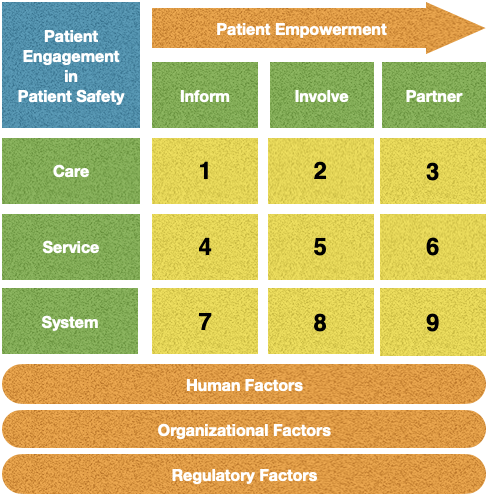
Engagement forms (horizontal) include inform, involve and partner. Informing means patients receive information but the communication is one way and the power lies with the care provider. Involving means patients have an active role with two-way communication but power still lies with the care provider. Partnering means that patients and providers work together and share equal power.
Engagement levels (vertical) include care, service and system. Care level is concerned with patient safety in relation to the specific interventions received and related risks. Service level is concerned with the organization’s safety performance and improvement activities. System level is concerned with setting priorities and policies and related strategies.
Influencing Factors
Numerous factors influence whether patients are able, willing or even permitted to engage.
Human or individual factors include knowledge, skills, attitudes (KSA) of patients and healthcare providers. KSA are numerous but the most essential is to have a relationship that is built on dignity, compassion and respect.
Organizational factors include leadership and culture, work climate, engagement structures and processes such as committees and policies, and patient advocacy groups.
Regulatory factors include laws and accreditation processes that mandate patient engagement and protect patient’s rights, educational regulations that incorporate patient engagement into undergraduate and postgraduate curricula thus ensuring the readiness of its graduate, integration of patient engagement into continuing professional development and revalidation systems.
Examples of Patient Engagement
1- Safety of care – Inform
Safety cards and/or animated videos informing and encouraging patients coming into hospital to engage in safety behaviour. Also, healthcare providers can communicate openly and honestly with patients and their families/carers following a patient safety incident.
2- Safety of care – Involve
Patients and families are encouraged to report harm using pre-printed cards with the aim of raising awareness and opportunities for staff to improve and provide safe care. Other methods of involvement include educational material that encourage patients to speak up to prevent errors in their care.
3- Safety of care – Partner
Patients and families are encouraged to be active partners in their own care through tracking and plotting of their medication and the relevant laboratory results making sure that they are within safe limits. A properly performed informed consent is a form of shared decision-making where the patient and healthcare provider work together to reach the most appropriate and safe decision for their care.
4- Safety of service – Inform
Measurements of commonly occurring harms within the service are regularly published and shared with patients and their families.
5- Safety of service – Involve
Patients and staff work together to design questionnaires and safety incident reporting tools based on patient experience and concerns. Patients may also share their experience and concerns regarding their safety with relevant committees and management/governing boards.
6- Safety of service – Partner
Patients, especially those who have suffered from harm or have been involved in error, may after adequate training, share in service improvement and/or deliver training workshops on patient safety to healthcare providers.
7- Safety of system – Inform
Patients and wider public can be informed about the national initiatives and policies aiming at improving the safety of the health care system.
8- Safety of system – Involve
Patients, carers and the public can be consulted through interviews and/or focus groups when developing patient safety policies and/or setting priorities.
9- Safety of system – Partner
When developing a national quality and safety policy and strategy patients can be active members of steering committees or working groups, taking and influencing decisions that ensure patient safety and their engagement.
Reading Material
-
- Towards eliminating avoidable harm in health care. Global Patient Safety Action Plan 2021–2030. WHO. 2021.
- Carman KL, et al. Patient and family engagement: A framework for understanding the elements and developing interventions and policies. Health Affairs. 2013;32:223-9
- Patient engagement in patient safety: A framework for the NHS. YQSR. 2016.
- Framework for involving patients in patient safety. NHS.2021.